Home
News
People
Prof. Kulik
Group Members
Alumni
Tutorials
molSimplify
MOFSimplify
Publications
Contact
2
Roadmap on Machine Learning in Electronic Structure
In recent years, we have been witnessing a paradigm shift in computational materials science. In fact, traditional methods, mostly …
Heather J. Kulik
,
Thomas Hammerschmidt
,
Jonathan Schmidt
,
Silvana Botti
,
Miguel A. L. Marques
,
Mario Boley
,
Matthias Scheffler
,
Milica Todorović
,
Patrick Rinke
,
Corey Oses
,
Andriy Smolyanyuk
,
Stefano Curtarolo
,
Alexandre Tkatchenko
,
Albert Bartok
,
Sergei Manzhos
,
Manabu Ihara
,
Tucker Carrington
,
Jörg Behler
,
Olexandr Isayev
,
Max Veit
,
Andrea Grisafi
,
Jigyasa Nigam
,
Michele Ceriotti
,
Kristoff T Schütt
,
Julia Westermayr
,
Michael Gastegger
,
Reinhard Maurer
,
Bhupalee Kalita
,
Kieron Burke
,
Ryo Nagai
,
Ryosuke Akashi
,
Osamu Sugino
,
Jan Hermann
,
Frank Noé
,
Sebastiano Pilati
,
Claudia Draxl
,
Martin Kuban
,
Santiago Rigamonti
,
Markus Scheidgen
,
Marco Esters
,
David Hicks
,
Cormac Toher
,
Prasanna Balachandran
,
Isaac Tamblyn
,
Stephen Whitelam
,
Colin Bellinger
,
Luca M. Ghiringhelli
PDF
Cite
DOI
Influence of the Greater Protein Environment on the Electrostatic Potential in Metalloenzyme Active Sites: The Case of Formate Dehydrogenase
The Mo/W-containing metalloenzyme formate dehydrogenase (FDH) is an efficient and selective natural catalyst that reversibly converts …
Azadeh Nazemi
,
Adam H. Steeves
,
David Kastner
,
Heather J. Kulik
PDF
Cite
DOI
ChemRxiv
What's Left for a Computational Chemist To Do in the Age of Machine Learning?
Machine learning (ML) has become a central focus of the computational chemistry community. I will first discuss my personal history in …
Heather J. Kulik
PDF
Cite
DOI
Are Vanadium Intermediates Suitable Mimics in Non-Heme Iron Enzymes? An Electronic Structure Analysis
Vanadyl intermediates are frequently used as mimics for the fleeting Fe(IV)═O intermediate in non-heme iron enzymes that catalyze C–H …
Vyshnavi Vennelakanti
,
Rimsha Mehmood
,
Heather J. Kulik
PDF
Cite
DOI
ChemRxiv
Audacity of huge: overcoming challenges of data scarcity and data quality for machine learning in computational materials discovery
Machine learning (ML)-accelerated discovery requires large amounts of high-fidelity data to reveal predictive structure–property …
Aditya Nandy
,
Chenru Duan
,
Heather J. Kulik
PDF
Cite
DOI
arXiv
Computational Modeling of Conformer Stability in Benenodin-1, a Thermally Actuated Lasso Peptide Switch
Benenodin-1 is a thermally actuated lasso peptide rotaxane switch with two primary translational isomers that differ in the relative …
Zhongyue Yang
,
Natalia Hajlasz
,
Heather J. Kulik
PDF
Cite
DOI
ChemRxiv
Computational Scaling Relationships Predict Experimental Activity and Rate Limiting Behavior in Homogenous Water Oxidation
While computational screening with first-principles density functional theory (DFT) is essential for evaluating candidate catalysts, …
Daniel R. Harper
,
Heather J. Kulik
PDF
Cite
DOI
ChemRxiv
Detection of multi-reference character imbalances enables a transfer learning approach for chemical discovery with coupled cluster accuracy at DFT cost
Appropriately identifying and treating molecules and materials with significant multi-reference (MR) character is crucial for achieving …
Chenru Duan
,
Daniel B. K. Chu
,
Aditya Nandy
,
Heather J. Kulik
PDF
Cite
DOI
arXiv
Eliminating Delocalization Error to Improve Heterogeneous Catalysis Predictions with Molecular DFT+U
Approximate semilocal density functional theory (DFT) is known to underestimate surface formation energies yet paradoxically overbind …
Akash Bajaj
,
Heather J. Kulik
PDF
Cite
DOI
arXiv
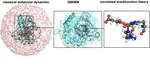
Harder, better, faster, stronger: large-scale QM and QM/MM for predictive modeling in enzymes and proteins
Computational prediction of enzyme mechanism and protein function requires accurate physics-based models and suitable sampling. We …
Vyshnavi Vennelakanti
,
Azadeh Nazemi
,
Rimsha Mehmood
,
Adam H. Steeves
,
Heather J. Kulik
PDF
Cite
DOI
arXiv
«
»
Cite
×